Tuesday, September 26, 2006

Chains! These are chains!

I was pretty angry driving home from work today. It wasn't the hour long commute, though that usually gets me a little worked up, especially when I fail to make the turn onto the parkway and wander aimlessly through southeast DC.

Rather, it was listening to congressmen on the radio baldly assault the underpinnings of American democracy. I'm referring to the current rash of voter identification laws, the most recent of which is the Federal Election Integrity Act of 2006. I'll quote Peter Kirsanow of the National Review for the meat of the act's provisions:
The Federal Election Integrity Act of 2006 requires that by the 2008 presidential election all voters in federal elections must present a valid, current photo ID issued by a government agency. By the 2010 midterms, the photo ID must document the voter’s U.S. citizenship.

The Congressional Budget Office estimates that the IDs would cost about $10 each. The act requires that states reimburse the cost of the ID to any voter who attests that he can’t pay for an ID.
Mr. Kirsanow speaks for many of the act's supporters when he touts the prospective advantages of the act in eliminating fradulent voters (wherever they may be) in exchange for what he presents as a nominal fee:
A one-time fee of $10 dollars doesn’t present the same barrier to voting as the poll taxes of the past, especially when the act would provide valid IDs to the poor free of charge.
I concede; Mr. Kirsanow and supporters of the act are correct in that $10 is a relatively nominal fee, and does not present the same sort of systematic disenfranchisement that poll taxes on African Americans created in the post-Civil War south. What enrages me is that Mr. Kirsanow and the act's supporters think that it is acceptable to impose any sort of fee on my ability to exercise my vote. It's not enough that Election Day isn't a national holiday. It isn't enough that thanks to the Electoral college, my vote has little or no impact on the overall outcome of presidential elections. It isn't enough that I am denied voting representation in Congress by virtue of my residence in the District of Columbia, but that I must be dunned $10 at the door by a pack of tipstaffs. Viewed in terms of an economic analysis, my vote is next to worthless. Because the outcome will likely be the same whether I vote or no, I receive more utility on Election Day by performing almost any other activity, from going to the dentist to washing my laundry. The vote is the one day of the year that our elected officials receive feedback from voters that they have no choice but to listen to. It tells them how disaffected the populace is, and how many of them are willing to do something about it. It is not a service that government provides to the people. Rather, we provide them a service by doing voting; if anything, our elected should give me $10. At the least, they should refrain from charging me for my presence, however nominal the fee is. Imposing any fee, even a nominal charge, is an insult to the American traditions of universal suffrage and poisonous to efforts to revive any interest in American democracy. It is not as if the American populace is enthusiastic about voting. Long poll lines are an indication of the antiquated or juvenile nature of our voting system, not of robust citizen participation. In an age where voter turnout, even in presidential election years, hovers around the 50% mark, it is infamous to speak of any monetary barrier, no matter how minimal, attached to the franchise. Let us aside the question of whether sufficient voter fraud occurs at the polls to warrant increased safeguards. Let us have increased security, if you must, but why pursue a course of action that must necessarily decrease voter participation?

It is infamous to seek to attach any additional burden to identification necessary to vote. It smacks of Dickensian grave-robbers rooting through the pockets of a corpse for half-crowns, of an elderly rabble of bawds clutching at my shirt-sleeve, offering to show me behind the tent-flap the withered paps of the Goddess Liberty for a mere $10. It is a slap in the face to those of us who still choose to show ourselves at the polls and do our civic duty through a solemn sense of pride and stubborn faith in the promise of this republic. This vote is mine by virtue of my being born by the grace of God an American, and I resent the grasping reek of the petty bureaucrat I scent in every sentence of the so-called Federal Election Integrity Act. The crack of the lash does not hurt the lion, yet he still resents the hoops the ringmaster forces him through. $10 will not break my bank, but it will be one more petty humiliation to endure in exchange for participation, however small, in American democracy. Some people will choose not to submit themselves to that yoke, and we will all be the poorer for it.

Sunday, September 24, 2006

Awesome

Property class, that is.
Suppose that A and B are killed while riding in a car struck by a train. When witnesses arrive, there are no signs of life in A; B is decapitated and blood is gushing from her neck in spurts. Does B survive A? See Gray v. Sawyer, 247 S.W.2d 496 (Ky. 1952) (Property, Dukeminier, Krier, Alexander, Schill; 6th Edition; p. 284)
That's almost enough to make me want to activate my Lexis and Westlaw accounts to see what the "answer" "is." But, really, it's much more fun to wonder.

Monday, September 18, 2006

The Bar to End All Bars

Sorry for my absence. My mind has been heavily weighted with concern about, what I thought would be, my certain failure on the examination that determines whether the way I've spent the last 8 years of my life was a ridiculous pipe dream.

Alas, it was not a dream. I passed the bar. The crushing weight placed on my soul since the moment I was handed my law degree has been lifted.

My snarky political comments will soon return in full-force.

Now if only I could find a fucking job.................

Friday, September 15, 2006

Let's get medieval

Digging a dry moat around Baghdad--sweet. I can hardly wait for the walls and the first portcullis.

Oh, wait. They're essentially doing that, too.

Tuesday, September 12, 2006

What we did

I worked at the MAS. The MAS did this. Though I had nothing at all to do with it, it makes me proud.

I'm glad the season's over.

Saturday, September 09, 2006

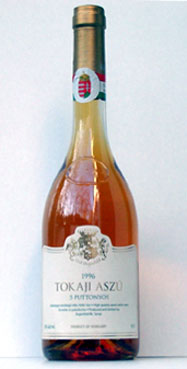
Tokaji--Rex Vinorum

I wholeheartedly support Tokaji Aszu as a dessert wine. It was the first wine I ever gave to Tracy; and the previous occupant, a Hungarian, happened to leave a bottle in the fridge. It has a wonderful Hungarian backstory to it: popes and kings used to swill the stuff by the hogshead, or compete to give their pet philosopher the finest glass available.

Tokaji is divided based on how many containers, or puttonyos, go into the cask the bottles are drawn from. The one in the fridge now is three puttonyos, which is a little bitter for me--I prefer up around five puttonyos, which is probably a bit sweet for most people. Here, though, I feel like I can taste a bit too much of the noble rot, a benign fungus that concentrates the sugars in the wine.

All in all, it's a decidedly decadent life I'm living right now, sipping my Tokaji upon the tiger rug Tracy's parents have given us.

Wednesday, September 06, 2006

In the "no shit" department

New Yorkers Still Apprehensive 5 Years after 9/11
Five years after 9/11, two-thirds of New Yorkers say they are still “very concerned” about another attack on their city, a level of apprehension only slightly reduced from the fall of 2001, according to the latest New York Times/CBS News polls of the nation and New York City.
...

Outside of New York, Americans, in many ways, have adjusted to the “new normal” of the post-9/11 era, the national survey suggests. In contrast to the frantic fall of 2001, their fears of another attack seem less acute and personal: Only 22 percent in the national poll said they were still “very concerned” about an attack in the area where they live, down from 39 percent five years ago. Three fourths said daily life has largely returned to normal.

But New Yorkers were more likely to say that they, personally, feel uneasy about the prospect of terrorist attacks. They were also less likely to say the federal government had done all that “could be reasonably expected” to protect the nation from future terrorist attacks; 72 percent of New Yorkers said the government could do more, compared to 58 percent in the national survey.

Maybe if there's a terrorist attack in Midland or Dubuque people'll feel different. Actually, I'm not quite sure why this makes me so mad--maybe something about the idiocy of how security funding is allocated--but suffice it to say, it does.

Monday, September 04, 2006

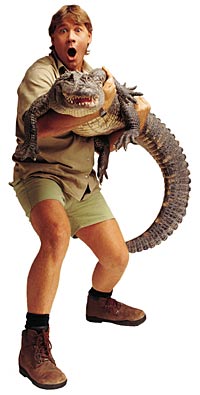
Steve, we hardly knew ye

I don't know what to do with days like yesterday. I saw a former professor, and had a blast at a Washington Nationals game where the Nats came from behind to sweep the Arizona Diamondbacks, 5-1. Then when we came home, a police car blazed down the street, lights flashing, and stopped outside our apartment building. We come up the block to find a friend of mine with a bloody nose, surrounded by cops. It turns out he was mugged at the street entrance of the condo Tracy and I just bought--they caught three kids around the corner and he ID'd one.

Then later that night, I learned that Steve Irwin had been finally brought down by a stingray spike through the chest. Requiescat in pace. I'm ready to move to the next week, please.

Saturday, September 02, 2006

Vista

In the interview posted by Microsoft, Mr. Hallauer said Vista would have fewer dreaded “blue screens of death,” in which the operating system freezes and leaves the user with a blue display screen. Instead, Vista will automatically recover from such freezes and start over, without forcing the user to restart the system manually. (NYT)
And this is progress?

Let's be honest here

I hate and am fascinated by pictures/retellings of 9/11 and/or the World Trade Center.

(Edited 9/3)